Every production leaves traces in the frame that were never meant to be seen: safety wires, rigs, tracking markers, a boom in the corner, a modern sign on a period street. Paint and cleanup is the VFX work that removes them and rebuilds what should have been behind them.
Done well, it is invisible. Done badly, it shows up as a smeared patch, a texture that doesn’t move with the camera or a flat area with no grain. This guide explains the types of paint work, how clean plates are made, why camera movement changes everything, and what to check and send when you brief it.
Types of paint and cleanup work
“Paint” (sometimes “prep”) covers several related tasks. Most shot lists use these categories:
Wire and rig removal
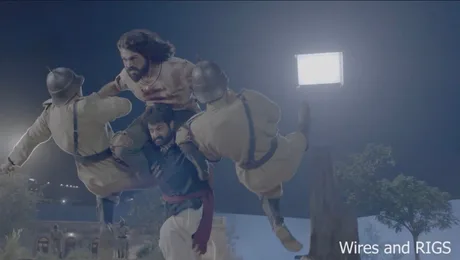
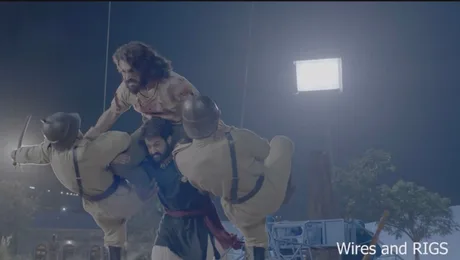
Removing the wires, harnesses, arms, stands and cranes used for stunts, flying effects and suspended props, along with puppeteers in green suits. Thin wires against a plain sky are quick; wires crossing hair, costume or smoke take much longer. See wire and rig removal services.
Tracking marker removal
Painting out the markers placed on screens, walls, props and sometimes performers to help camera tracking. Markers on a flat green screen are usually straightforward once the shot is keyed; markers on skin or moving fabric need tracked patches. See marker removal services.
Object and logo removal
Removing anything that shouldn’t be in the final image: crew reflections, equipment, signage, brand logos that haven’t been cleared, modern details in a period setting.
Beauty cleanup
Cosmetic work on performers — blemishes, tattoos, stray hairs, make-up lines, sweat — that must follow facial movement while keeping natural skin texture. See beauty cleanup services.
Clean plate creation
Building a version of the background with the subject or an object removed, so it can be used to fill revealed areas, support a set extension or serve as a base for compositing.
Clean plates and how they are made
Removing something from a frame is only half the job; the harder half is deciding what goes in its place. That replacement image is the clean plate, and there are three main ways to get one.
A clean pass shot on set
The most reliable source is a pass filmed on set with the same framing and lighting but without the performer, rig or object. On a locked-off camera this can be as simple as an extra take of the empty set. On a moving camera, a repeatable motion-control move or a careful matching pass gives the best result. Even an imperfect clean pass gives the paint artist real background detail to work from.
Frame patching
Where there is no clean pass, artists borrow pixels from elsewhere in the shot. If the unwanted element moves, the background it covers in one frame is often visible in another, so that area can be copied across and aligned. Artists also clone texture from nearby parts of the same frame. Patches are tracked so they move with the background and are blended so the join is invisible.
Projection
On shots with significant camera movement and parallax, a flat patch can’t follow surfaces at different depths. Here the clean background is painted once, on a single frame, and projected onto simple 3D geometry through a tracked camera. The projection then moves with correct perspective across the shot. This approach relies on a good camera track.
Static versus moving camera
Camera movement is the biggest single factor in how long a paint shot takes.
| Factor | Locked-off camera | Moving camera |
|---|---|---|
| Clean plate | One painted frame can often cover the whole shot | Background changes every frame; needs tracking or projection |
| Tracking | Little or none for the background | 2D, planar or 3D tracking required |
| Parallax | None | Surfaces at different depths move differently |
| Lighting changes | Mainly from the action | Reflections and highlights shift with the camera |
| Relative effort | Lower | Higher, rising with movement and depth |
Handheld footage sits in between: it moves constantly but often within a small range, so 2D and planar tracking can handle much of it.
Grain management
Every plate carries grain or sensor noise, and it is different in each colour channel and at each brightness level. A painted patch copied from another frame carries that frame’s grain, frozen; a patch from a still has none at all. Either way, the repaired area stops “living” like the rest of the image.
The standard approach is to de-grain the plate, do the paint work on the clean image, and then re-grain the result with grain that matches the original. Some artists instead keep the original grain and only rebuild it inside the patched area. Either way, grain match is one of the first things a supervisor checks.
What drives the effort on a paint shot
Paint is usually scoped shot by shot, because two removals that sound identical on a shot list can differ greatly in effort. When a vendor reviews your footage, these are the questions they are answering:
- What is behind the element? A plain wall or sky can be rebuilt quickly. Foliage, crowds, water, smoke, text and fine repeating patterns have to be reconstructed in detail.
- Does the element cross the subject? A wire passing over hair or a rig hidden behind a moving costume means the performer must be protected with roto and the gap rebuilt around them.
- How large is it in frame, and for how long? A marker that appears for twenty frames in a corner is a different job from a crane that fills a third of the frame for the whole shot.
- Is there a clean pass? Real background detail shortens the work and improves the result.
- Is there motion blur, defocus or interactive light? The rebuilt area has to match the blur and focus of the plate, and any shadows or reflections the element cast must go too.
Sharing these details in the brief, or simply sending a few representative frames, lets a vendor quote accurately rather than allowing for the worst case.
On-set choices that make cleanup easier or harder
Many cleanup costs are decided on the day of the shoot. If you are in pre-production, these choices help:
- Shoot a clean pass whenever a rig, wire or performer is to be removed, with the same lens, framing and lighting. On a moving camera, repeat the move as closely as possible.
- Keep rigs and wires off the subject where possible. A wire against a plain wall is far quicker to remove than a wire crossing hair or a patterned costume.
- Use thin, non-reflective wires and colour them to suit the background, not the screen.
- Size tracking markers for the shot. Use as few as the tracker needs, and keep them off performers’ faces unless face tracking requires it.
- Avoid unnecessary interaction between rigs and smoke, water, dust or fine foliage, which are slow to rebuild.
- Capture reference: photos of the set without equipment, and textures of surfaces that will be revealed.
- Note what is to be removed in the camera report, so editorial and VFX know from the start.
A few seconds of clean pass on set can save days of paint work on a long moving shot. If the schedule only allows one extra take, it is usually worth spending it on the hardest removal.
Quality checks for paint work
Paint is reviewed in playback, at full resolution, and often with the contrast pushed so faults are easier to see. A supervisor will look for:
- Visible patches — a soft or smeared area, or a repeated texture where the same detail has been cloned twice.
- Sliding — a patch that doesn’t stay locked to the background as the camera moves.
- Grain mismatch — a repaired area that is cleaner or noisier than its surroundings, or with grain that doesn’t move.
- Flicker or boiling — a patch that changes slightly from frame to frame.
- Remnants — the end of a wire, a shadow or reflection of the rig, or a marker partly hidden at the edge of the frame.
- Edge problems — damage to the performer or object next to the removal, such as clipped hair.
- Technical issues — wrong frame range, colour space changes, or pixels altered outside the work area.
Shadows and reflections are easy to miss: removing a rig but leaving its shadow on the floor is a common note. At RotoEdge, quality assurance is a dedicated stage of our five-stage process, before delivery.
How to brief paint and cleanup
A paint brief should make it impossible to misunderstand what is to be removed. For each shot, send:
- Shot ID and frame range, including handles
- A marked-up frame or notes listing every element to remove, including shadows and reflections
- Any clean passes, reference stills or set photos
- Whether the work is a temp or a final
- Delivery format, colour space and naming convention
- Whether grain should be matched to the plate or delivered de-grained
- Any other work planned on the same shot, such as roto, keying or compositing
- The deadline and the number of review rounds expected
Paint is rarely isolated from other work. Removing a rig behind an actor usually needs roto to protect the performer, and the result often feeds a composite. Briefing these together avoids duplicated effort.
In summary
Paint and cleanup removes what the production needed on set but the audience must never see. The effort depends on what is being removed, what is behind it and how the camera moves, and the quality is judged in motion: patches must stay locked, grain must match and nothing should be left behind.
To discuss cleanup on your project, see our paint and cleanup services or browse paint and cleanup work examples.